
Background
Communication is at the root of safe, quality health and social care. Good communication builds relationships and trust, facilitates shared decision making, increases patient satisfaction and improves health outcomes. Poor communication can fracture relationships, contribute to mistakes and errors, increases treatment non-compliance and diminishes health outcomes. Poor communication costs money in time, treatments and care, complaints management and litigation outcomes. It also contributes to professional stress.
Advanced communication skills training (ASCT) has been delivered across Northern Ireland since 2009, driven by strategic developments in cancer and palliative care services. The importance of this work is reinforrced in the the NI Cancer Strategy (2022) sets out, in Action 53 that: ‘all health-care professionals who are expected to carry out sensitive communication must complete an advanced communication skills training programme’.
All HSC Trusts deliver a two-day Advanced Communication Skills Training Course based on the Wilkinson model. Courses are facilitated by two specially trained facilitators and are delivered to small groups of six participants creating a supportive and highly interactive learning environment. Professional actors, trained in the course methodology, simulate the patient/relative and colleague scenarios role in role-play.
The programme continues to receive consistently high evaluation scores from participants, who report increased confidence and competence in conducting sensitive and challenging conversations. Emerging evidence also demonstrates a positive longer-term impact on professional practice, supporting improvements in both staff experience and patient-centred care.
Who is the course for?
This course is relevant for senior health and social care professionals who undertake sensitive or complex discussions with patients and those important to them regardless of their disease/illness. However, as courses are currently being financially supported through NI Cancer Strategy funding, places are prioritised for professionals working in key groups in cancer and palliative care services in HSC Trusts and hospices across NI.
Advanced communication skills training is a mandatory requirement within peer review for core members of cancer care multi-disciplinary teams and is an essential criterion in many cancer and palliative care job descriptions.
Learning Outcomes: This course enables participants to:
- explore optimal communication skills,
- examine approaches to structuring complex conversations,
- practise effective communication strategies in challenging scenarios in a safe environment, and
- reflect on and critically appraise their, and their fellow participants’ communication skills.
Teaching Methods: Drawing on learner-centred, experiential learning methods:
- the importance of effective communication and core communication skills theory is revisited through presentations and discussions,
- strategies to structure communication in various scenarios are introduced through slides and demonstration videos,
- mandatory video recorded role play with an actor enables participants to practise communication skills, recognise their communication strengths and grow awareness of how facilitative communication skills and strategies can positively influence the outcomes of communication encounters.
For more information in your own Trust please contact:
- Belfast HSC Trust: Rebecca Burns: Rebecca.Burns@belfasttrust.hscni.net
- Northern HSC Trust: Fiona Gilmour: Fiona.Gilmour2@northerntrust.hscni.net
- South Eastern HSC Trust: Lynda Bell: Lynda.Bell2@setrust.hscni.net
- Southern HSC Trust: Clair Quin: Clair.Quin@southerntrust.hscni.net
- Western HSC Trust: Emma King: Emma.King@westerntrust.hscni.net
Or
- Regional ACST programme lead: Sharon McCloskey: Sharon.McCloskey@hscni.net
 Advanced Communication Skills Training Showcased at International Healthcare Conference
The importance of effective communication in healthcare was highlighted at the recent International Conference on Communication in Healthcare, held in Belfast. The conference brought together international experts to explore how communication contributes to improving patient experience, patient safety, workforce wellbeing and public trust.
Representing the regional Advanced Communication Skills Training (ACST) Programme, Dr Sharon McCloskey, Regional ACST Programme Lead, shared the progress and impact of the programme in developing advanced communication skills across Northern Ireland’s health and social care workforce.
A recurring theme throughout the conference was the recognition that communication is a core clinical skill that can be learned, practised and continually refined. Speakers emphasised that high-quality communication delivers tangible benefits for patients, families and healthcare professionals alike.
Discussions also focused on the importance of moving beyond doing things for patients and instead working with patients as active partners in their care. Professor Barello highlighted the value of not only training individuals in communication skills but also designing healthcare systems and environments that enable and support effective communication.
One particularly impactful message came from Professor Jeremy Howick:
“Adding a dose of empathy into every health consultation increases patient satisfaction and experience by 10%, and reduces the odds of patient complaints by 80%.”
Howick J. (2025), Empathic Healthcare: Improving Patient and Staff Satisfaction in the NHS, University of Leicester.
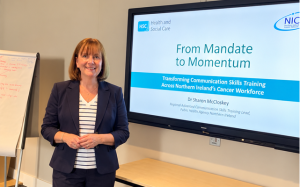 The conference reinforced the growing evidence that empathy, compassionate communication and meaningful patient engagement are fundamental to delivering safe, effective and person-centred care. These principles remain at the heart of the ACST Programme and continue to underpin its contribution to improving experiences and outcomes for people receiving health and social care services across Northern Ireland.